


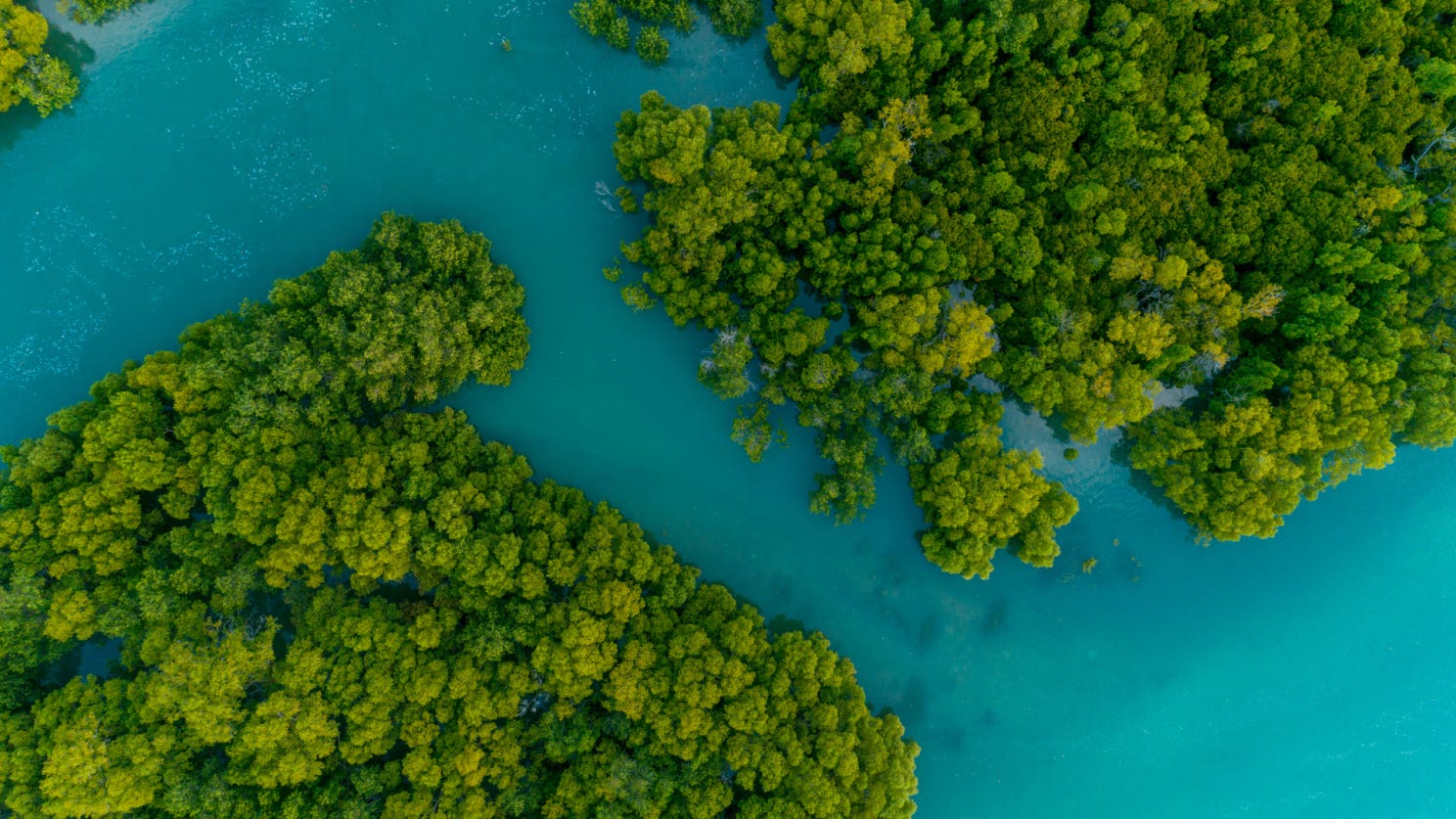
For decades, the world’s coastal mangrove forests were disappearing, cleared to make way for fish farms, rice fields, and development.
Why do we care? Mangroves sequester carbon, buffer coastlines from storm surge (which is getting worse thanks to climate change), provide critical nursery habitat for fish, and filter pollutants from coastal waters.
Now, a new study found that since 2010, mangrove regrowth around the world has been outpacing losses. Forty years of satellite data from NASA’s Landsat program shows that the gains are driven by mangroves both expanding into new habitats and regenerating in places where they once grew. After decades of decline, the recovery has accelerated so sharply that earlier losses have nearly been erased.
Scientists call it a genuine global rebound, propelled by a combination of careful conservation work ( The Nature Conservancy Science does a lot of this!) and natural regrowth.
“What we’re seeing now is a real shift. Mangroves are now showing a net increase globally, and the rate of degradation is slowing,” said Dan Friess, a professor at Tulane University and director of The Mangrove Lab. “While some mangroves are still being lost, this could make them a rare conservation success story and an important source of optimism for climate action.”
This study is more proof that when we protect nature, it can recover.


I often mention the costs of climate change to the global economy. But a new study makes the case that biodiversity loss, too, carries its own enormous price tag — one that financial markets have yet to reckon with.
The research conducted by a team of UK economists found that the partial collapse of the “ecosystem services” of tropical timber, wild pollination, and marine fisheries could dramatically increase the cost of borrowing for 23 nations representing 5.5 billion people. In this scenario, India’s annual debt servicing costs could rise by $49 billion and China’s by $70 billion. Across all countries studied, additional interest payments could reach $162 billion every year. Angola, Bangladesh, the Democratic Republic of the Congo, and Madagascar could see GDP losses exceeding 15% by 2030.
And yet today’s credit rating models don’t account for any of this. The risk is already there but markets just haven’t priced it in yet. That means $83 trillion in financial assets may be mis-priced.
The study’s lead author, Professor Matthew Agarwala of the University of Sussex, didn’t mince words about what’s at stake:
“It’s not just financiers who will lose out. As nature loss reduces economic performance, it will become harder for countries to service their debt, straining government budgets and forcing them to raise taxes, cut spending, or push inflation even higher,” he said. “The consequences could be grim. Governments face a stark choice—pay now, by investing in nature recovery, or pay later through higher borrowing costs.”
When nature stops functioning, economies stop functioning. The two are inextricably intertwined.

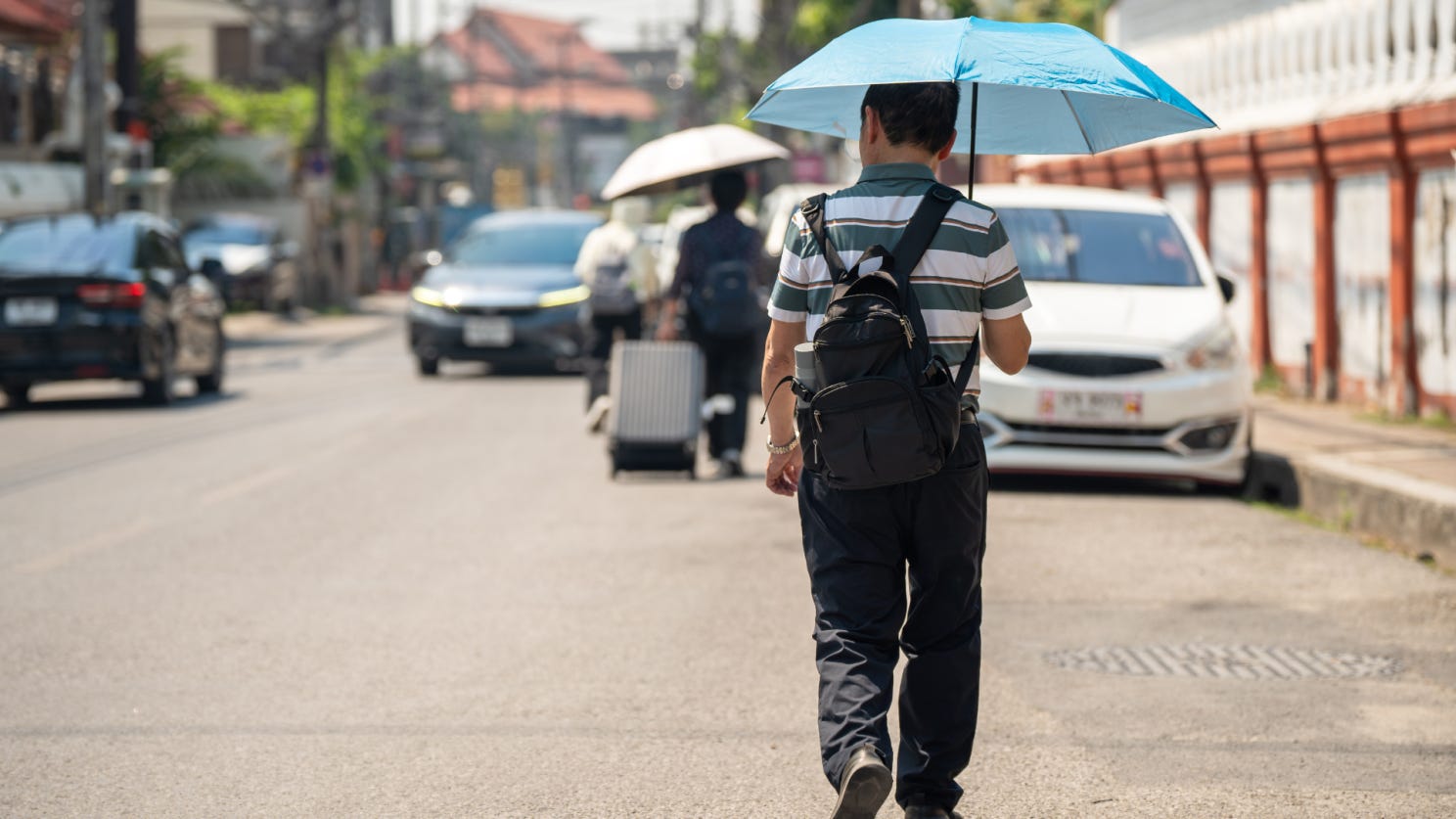
If you live in the Northern Hemisphere, we’re already well into a hot summer. Last week I talked about the heatwave in the EU and southern UK. This week, it was eastern North America’s turn. How unusual are the temperatures we’re experiencing during these heatwaves?
Reuters just launched Climate Monitor, an interactive globe showing how much hotter (or colder) today’s temperature is compared to what was typical on that date between 1961 and 1990. I spent a few minutes on the site this weekend. Where I live in Dallas: 4.7 degrees Fahrenheit (that’s 2.6C) above normal this past week. Toronto, Ontario, my hometown: 19.6F or 11C degrees above normal. 11C above normal is incredible to me, and in case you didn’t know, Toronto’s one of the World Cup cities with an outdoor stadium! That stopped me in my tracks.
Last week, Philadelphia cancelled their 250 year celebration parade as the heat index soared to 118F on July 3, and in DC, temperatures 22F above normal led to the daytime closing of the Great American Fair on the Mall and the cancellation of the July 4th parade.
This week, take just a minute and look up your city. Look up where your parents live, where your kids go to camp, or somewhere currently experiencing a heat emergency. And don’t stop there. Talk about it! Share what you find out — not as a lecture, but as a conversation starter: “Did you know it’s 6 degrees warmer than normal here right now? I just found this tool that shows you in real time.”
Abstract statistics about global average temperatures are easy to dismiss. But when someone sees that their hometown is running 8 degrees hotter than usual, or that the town where their grandchildren live is having its warmest July on record, it hits differently. Climate change stops being a headline and feels personal.
Katharine, i want to ask, if we accept that emissions cuts won’t stabilize the jet stream such that the heat domes we face aren’t any less severe than they are today (they occur as early as march to as late as October), should we really assume that we can adapt to this happening in perpetuity? We can and should plant trees, and utilize reflective material as well as passive cooling and all of that (including air conditioning/heat pumps, and overhauling our power grids to support constant demand), but this only can do so much in a heat domes where it gets extremely humid and does not cool off at night. Heat domes already can and often do reach the arctic circle, which obviously melts more ice and permafrost and further dries out boreal forests (which is one of the planets largest carbon sinks) leading to megafires that pollute the entire northern hemisphere with toxic smoke all summer long (these fires are overwhelmingly started by lightning strikes engendered by the atmospheric instability due to the wavy jet stream). I’m curious if there is anything that can be done to adress problems like Arctic Sea Ice melt and jet stream irregularities at the source (beyond cutting emissions) because I fear that emissions cuts alone will not suffice at restoring this (arctic ice provides an albedo effect that reflects solar radiation back into space, and as that has melted, that has destabilized the jet stream and meridional tempature gradients). I’m not trying to imply we’re doomed, i just wanted to add my perspective here.
One of the two tramps in *Waiting for Godot* says to his friend, "Nothing can be done." But the old adage keeps me going: "Pray as if everything depends on God; work as if everything depends on you." (Saint ) Padre Pio said, "Pray. Hope. And don't worry." A series of similar encouragements attributed to several authors includes: "Give the world the best you have and you may get kicked in the teeth. Give the world the best you've got anyway."