


Last week was my favourite NPR time of year: their fourth annual Climate Solutions Week! Given the wholesale dismantling of climate action at the national scale in the U.S., this year they’re focusing on climate solutions at the regional, state, city, and even neighborhood level. And the stories are so good, I can’t pick just one.
So here’s a few highlights:
This dispatch from Montana describes how some tribes are creating their own climate plans that incorporate Traditional Ecological Knowledge. The Confederated Salish and Kootenai Tribes’ plan focuses on reducing wildfire risk. Michael Durglo, the tribes’ climate change coordinator, has installed air quality sensors across the reservation. He’s also leading training sessions teaching people to build their own air filters to help during wildfire season.
This story from Utah details how a coalition of cities and towns in the conservative state are leading a push to transition to renewable energy. Today, three-quarters of Utah’s electricity comes from coal and natural gas. “The fact that our efforts here have been happening over the course of multiple federal administrations,” said Emily Quinton, sustainability director of Summit County, “shows that at the local level, you can continue to move on climate strategies regardless of the federal winds.”
Meanwhile, Denver CO has an ambitious plan to heat and cool its buildings downtown with geothermal energy, some of which will come from the warmth put out by treated wastewater. And Portland OR‘s had a billion-dollar climate fund since 2019, which residents created by passing a 1% sales tax on large corporations operating in the city limits. Since then, proceeds have built a community solar project, given out more than 20,000 free AC units to low-income families, and paid for energy retrofits of more than 3,000 homes.
You can find the full set of climate solution stories here, and I encourage you to listen to each and every one. We already have so many more solutions than most people realize: and when we see what others are doing, it gives us ideas for what to advocate for, where we live!


A new generation of climate scenarios is out, and it narrows the range of projected warming by 2100 compared to previous scenarios. Why? Because we’re now in the year 2026, and our past actions have now closed a number of doors.
Although the update reflects a sobering reality, there is some good news. The higher end of the scenarios -- which the world had been tracking with as recently as 2015, when the Paris Agreement was signed -- is now a bit lower, thanks to all the climate action that’s happened over the last decades. So don’t fall for the disinformation and hype that claims the higher scenario was alarmist and false. Back in 2005, it was very possible: and it served its purpose, warning us about what would happen if we continued on our current pathway.
Thankfully, enough people, countries, and organizations listened and took action to avert it. Instead of the virtually catastrophic 4-5C (7-9F) warming by 2100 that we used to be on track for, the world is now headed towards a lower but still dangerous 2.6C (4.7F) warming, thanks to all the climate policies and clean energy expansion of the last decade. That is a success to celebrate.
The bad news, however, is that the lower end of the scenarios is now higher, too. Specifically, thanks to insufficient emissions reductions over the last decade, limiting warming below 1.5C without an overshoot is no longer plausible. It is now virtually certain the world will exceed that threshold and the only question that remains is whether that overshoot will be permanent, or temporary -- in other words, will we be able to pull enough carbon out of the atmosphere to cool the planet back down, even if we deploy all the best nature-based solutions we have? The answer to that question is up to us.
The new scenarios, developed as part of the next major international climate modeling project known as CMIP7, are intended to guide global climate research for years to come. Our most likely future today may not be as catastrophic as the one we were heading to before the Paris Agreement. However, it’s also well beyond the safer limits set by that agreement. 1.5C isn’t a magic threshold: but what science says is that every fraction of a degree of warming matters. Additional warming intensifies heat waves, flooding, drought, freshwater scarcity, sea level rise, and many other impacts.
That’s why the most important message these new scenarios have for us is this: our future is in our hands and every choice matters.

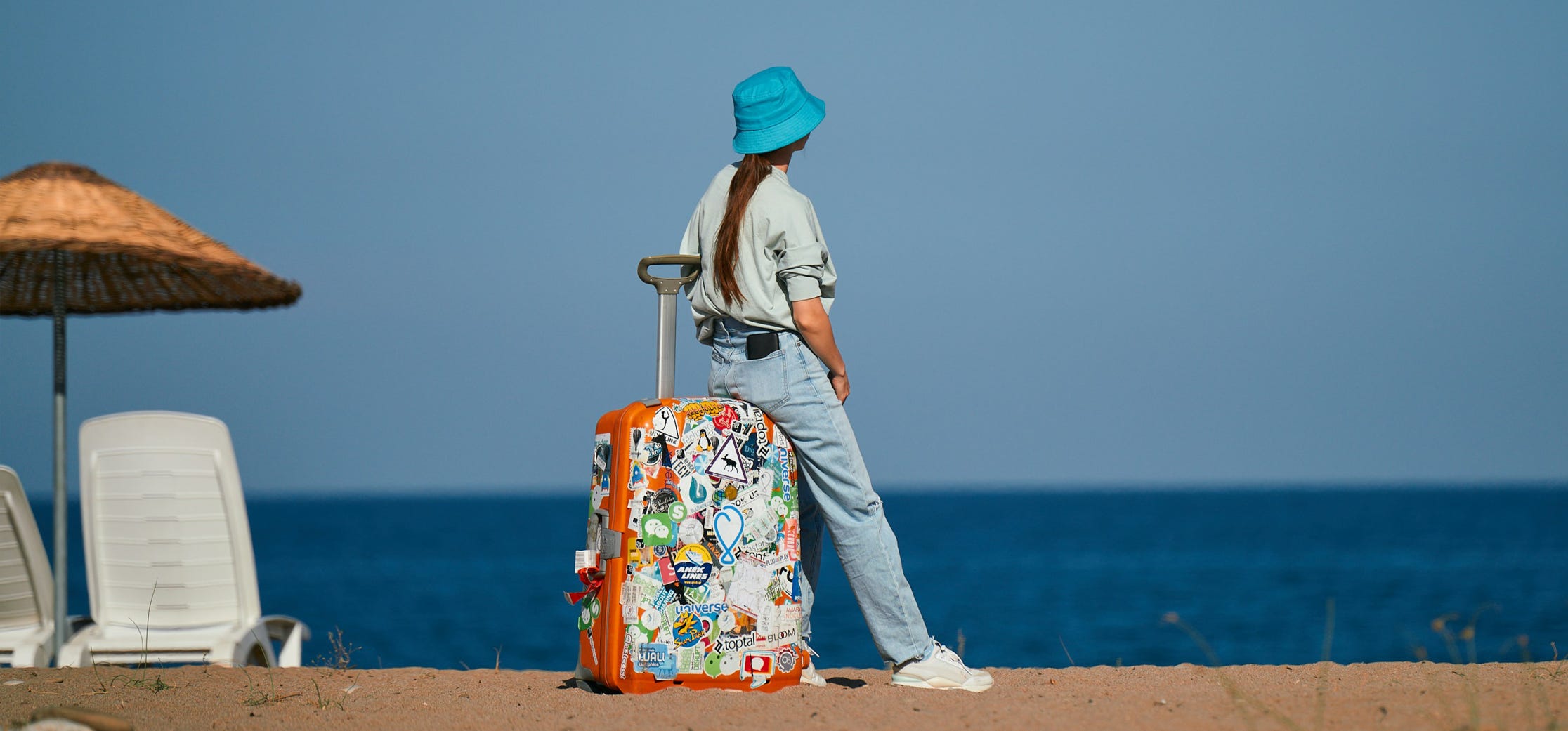
Summer is often a time when we travel; and flying remains one of the most carbon-intensive parts of modern life, especially on short trips where takeoff and landing consume the most fuel.
If you are flying this summer, small choices can help reduce your impact. (But you know what else I’m going to say - make sure you share what you know with others, to scale larger change!)
Two of my favourite solution scientists, Kimberly Nicholas and Jonathan Foley , were recently asked whether packing lighter helps cut emissions. Honestly, that doesn’t have a big impact, they found: but choosing nonstop flights and flying economy definitely helps. Travelling by car with others or taking the train if that’s an option can reduce emissions even further.
Sometimes, though, the most meaningful shift is simply slowing down. Staying longer in one place, exploring destinations closer to home, or choosing fewer trips with deeper experiences can reduce emissions while making travel feel less rushed and more memorable.
Whatever you choose: think about it, give it a try, and let others know what you did!

Thurs June 4 at 11am EDT - What We Don’t Know, and Why It Matters, a plenary presentation to the Canadian Meteorological and Oceanographic Society (CMOS) 60th Congress -- which is being held 100% online this year!
Wed June 17 6 at 5:30pm BST - The Financial Times Climate & Impact Summit - virtual presentation to an in-person event in London; prices vary
Hi Katharine - I'm a huge fan and long time follower. I'm concerned because in your article you say "small choices can help reduce your impact." Your are implying to people that the way to solve climate change is by reducing their individual carbon footprint, which is a falsehood started by oil company BP.
I'm a long-time follower and I love your good works explaining climate science to lay people and your displaying positive climate stories rather than gloom. As for the individual carbon footprint thing - Shouldn't we be telling people to support bigger systemic changes, as Greta Thunberg did, things like voting for climate-forward leaders, or at the very least, supporting area-wide renewable projects as the Utah coalition did in your article ? Thanks